


The learning outcomes are entirely focused on what the learner will be able to do/ know the end of the session. The learning outcomes are always written in the same way.
Example of learning outcomes:
By the end of the lesson, learners will be able:
Some educational settings expand on the learning outcomes to allow for differentiation of target setting for their learners.
Example of differentiated learning outcomes:
By the end of the lesson, all learners will be able:
By the end of the lesson, most learners will be able:
By the end of the lesson, some learners will be able:
The learning outcomes are not a list of everything that will be included in the lesson; they are the key targets for the learners and their success in achieving the targets is also a measure of the effectiveness of the lesson. The aim and the learning outcomes of the lesson should be shared with all learners at the beginning of the lesson and recapped at the end of the lesson so that learners can self-evaluate their progress. In the lesson plan, there is a section for reflection; one key element is to reflect if the learners have achieved the learning outcomes, or not. If learners have not achieved the learning outcomes within the lesson, then the teacher will need to adapt the next session, and possibly alter the SOW.
The learning outcomes must be ‘active’, this means that they always begin with a ‘verb’. Learning outcomes must also be SMART.
S Specific
It is important to be clear on what the learner will achieve. For example, does the teacher want the learner to provide 3 examples or 5?
M Measurable
Can the teacher and the learners identify if they have achieved the target? For example, can they list the four British Values, or not?
Do not use ‘understand’ in learning outcomes as it is not possible to measure if a learner has understood without giving them a measurable target.
A Achievable
Based on your learners starting point, are your learning outcomes achievable? Are they too simplistic or too complex?
R Relevant
Are the learning outcomes relevant to the qualification specification or content of the programme? Do the learners understand why they need to achieve the learning outcomes?
T Time-bound
Is there sufficient time within the planned session to achieve the learning outcomes.
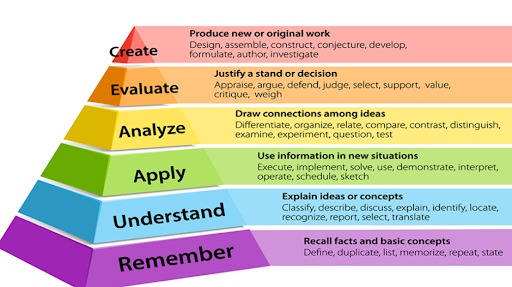
When writing learning objectives, it is helpful to refer to Bloom’s Taxonomy, which categorises learning into three domains: cognitive (knowledge), affective (attitudes), and psychomotor (skills). Created by Benjamin Bloom in the 1950s and revised in 2001, Bloom’s Taxonomy provides a structured way to identify the level of learning expected, ranging from basic recall of facts (remembering) to higher-order skills such as evaluating and creating. By using action verbs from Bloom’s Taxonomy, such as ‘list’, ‘describe’, ‘analyse’, or ‘create’, teachers can make learning outcomes clear, measurable, and appropriately challenging for learners. This helps ensure objectives are not only specific but also aligned with the desired depth and breadth of learning.
Developing effective learning outcomes requires a comprehensive initial assessment of the group, enabling instructors to accurately determine learners’ starting points. According to Bloom’s taxonomy, all individuals must begin at the foundational level, ‘remember’ and systematically progress by building their knowledge, understanding, and skills. Consequently, it is essential for teachers to identify the current stage of each learner to establish appropriately challenging objectives within lesson plans. For example, if learners are operating at the ‘apply’ level, this should be reflected in the learning outcomes. The accompanying chart provides recommended actions that demonstrate proficiency at various levels. Generally, those pursuing a Level 1 qualification will operate at the ‘remember’ stage, while learners working towards a Level 2 qualification should focus on the ‘understand’ stage, and so forth.
Linking Bloom’s domains to learning outcomes supports the creation of targets that are both measurable and achievable, as it encourages teachers to move beyond vague terms like ‘understand’ and instead specify observable behaviours. For example, instead of stating “learners will understand British Values,” a Bloom’s-informed objective would be “learners will be able to explain the four British Values.” This approach also aids in designing relevant activities and assessments that match the intended level of learning, ensuring that outcomes are meaningful and time-bound within the session.
If you want to take your career to the next level, check out our website and find the right course for you! Best for Training | Accredited Training & Course Specialists